
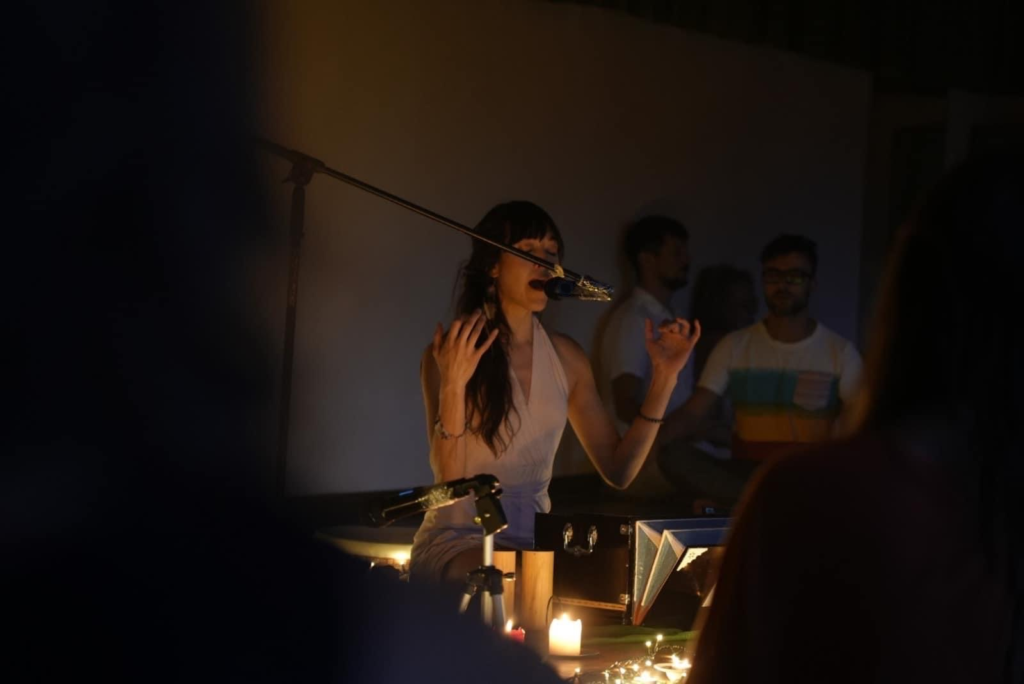
Julianna Bloodgood USA/ Poland, is a vocalist, actress, movement artist and teacher whose work includes anthropological performance research and she has traveled the globe extensively in search of different cultural perspectives on the body, voice and the ritual of performance. The core of her work is a detailed practice in the relationship between body and voice and how this can be brought to performance and composition. Julianna was a leading actress in the award winning and critically acclaimed Polish theatre company Song of the Goat Theatre from 2009-2019. She was an integral part of the development, devising, premiers and world tours of Songs of Lear; Portraits of the Cherry Orchard; Return to the Voice; Umilowanie: Dead Walk Love; Crazy God; Island and Hamlet: A Commentary. These performances have won prestigious theatre awards including the Edinburgh Fringe Festival’s Fringe First, Archangel Awards, UK Mustical Theatre Matters. Julianna’s work with Song of the Goat gained international attention and she participated in several world tours with the company. Julianna is also a resident artist with Theatre MITU based in New York City; is an associate artist with Bru Theatre of Ireland and Slovakian company Honey and Dust.
Julianna is an associate artist with Brú Theatre of Galway, Ireland, where much of her work has centered on lament and the voice. Most recently, she was the composer and vocal performer for Somnium, a company-devised piece that premiered at the Galway International Arts Festival to critical acclaim. In 2021, she composed, served as music director, and performed in Gol, which explored the tradition of Irish keening (caoineadh), the lament for the dead. She also directed the recordings of her compositions for Olagón, a virtual reality lament for the land, crafting the soundscape in collaboration with Brú and the ensemble of Gol. The work immerses audiences in the wild landscapes of western Ireland through the perspective of a single woman, whom she embodied.
Together with director and writer James Riordan of Brú Theatre, Julianna co-created Cráite, a solo script for a female performer that examines historical reconciliation through ‘long-form lament,’ supported by a bursary from the Abbey Theatre of Ireland. Their collaborations also include NOX, an experimental site-specific work of vocal and physical theatre inspired by Irish death laments and the women who carried this tradition, which premiered in Rijeka, Croatia.
In 2019, Julianna was awarded a scholarship from the Polish Ministry of Culture and National Heritage for her research and development of a script based on Saint Catherine of Siena, and in 2022 she directed, premiered and performed the piece entitled Little Thunder, in collaboration with composer Katarzyna Szwed and the Warsaw Stage Society: a theatrical concert exploring the line and lineage of female mystics.
Julianna internationally teaches her methodologies called Embodied Voice Practices, which is an in-depth research of the connection of the body and voice and its inherent healing capacities and the Polyphonic Body, a physical, vocal and ensemble based theatrical training. Julianna has a particular interest and research in the vocal practice of lamentation, which has become a through line in all of her work. She continues to research the technical, historical and contemporary aspects of lamentation. Julianna has a master’s degree with high honors from Manchester Metropolitan University; is a graduate of University of Cincinnati College Conservatory of Music, The Pacific Conservatory of the Performing arts and has a certification in Integrative Somatic Trauma Therapy. She has studied with vocalists, movement artists and somatic practitioners in the United States, throughout Europe, in India and Thailand.
Embodied Voice as Practice
This practice forms the foundation of my teaching and workshop work.
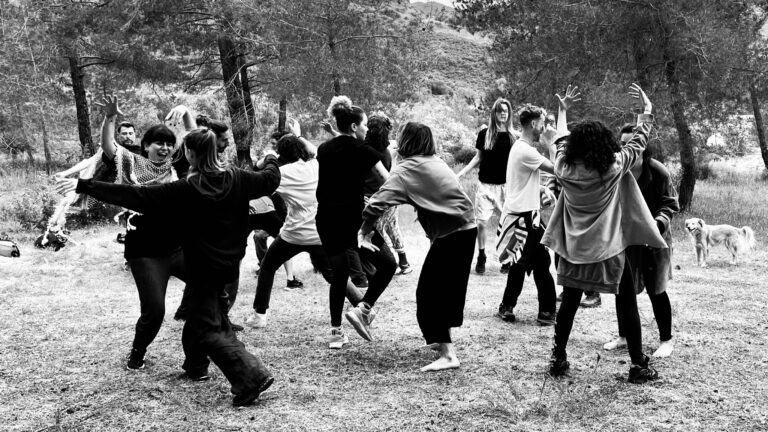
Embodied Voice Practices can be experienced as an in-depth exploration of voice as it is lived through the body and the space around us. The body is our gateway to all creative sources, and from the body we begin our investigation of voice, sounding, song, text, and musicality — through a dynamic exploration of the origins of sound. We deepen the body–voice connection by exploring how sound is physically experienced. Through a flow of movement and breath, we awaken sound vibrations within the body — resonating bones and tissues — creating a visceral understanding of the voice and enlivening new possibilities for song, text, vocal improvisation, and all forms of communication.